Do you ever wish you could create a mobility device for your child, that your child’s adapted tools were available in their favorite colors, or that you could easily obtain the next size product without having to prove need or disability to your insurance company? Parents of children with disabilities wrestle with costs, availability and accessibility of equipment, products and toys at each stage of development. The need has led to finding (or creating) personalized tools and products that eliminate overspending or insurance delays. Read on to learn about a few DIY adaptive solutions for families with disabilities.
The team at nonprofit MakeGood in New Orleans creates adaptive products and mobility devices that can be printed on an average 3D printer. The DIY plans can be downloaded for free as they are funded through community partners and donations. MakeGood devices include adapted guitar picks, card holders, phone cuffs, writing supports, gaming supports and power chair accessories such as seatbelt docks, cupholders, auto-close hangers and trays. If parents don’t own their own 3D printer (which costs $350-$400), San Diegans can make an appointment online at the Downtown Library’s IDEA Lab and use theirs. Larger projects may require multiple appointments.
The MakeGood team truly understands inclusive innovation. Their board and design team includes a non-speaking, quadriplegic, residential and commercial builder, a C-5 quadriplegic engineer with advanced computation design skills in 3D printing and adaptive equipment, a prosthetic skills engineer with a congenital limb difference, an advocate and Doctor of Disability Studies with cerebral palsy, a bilingual Doctor of Rehabilitation Counseling, and a gaming and VR educator.
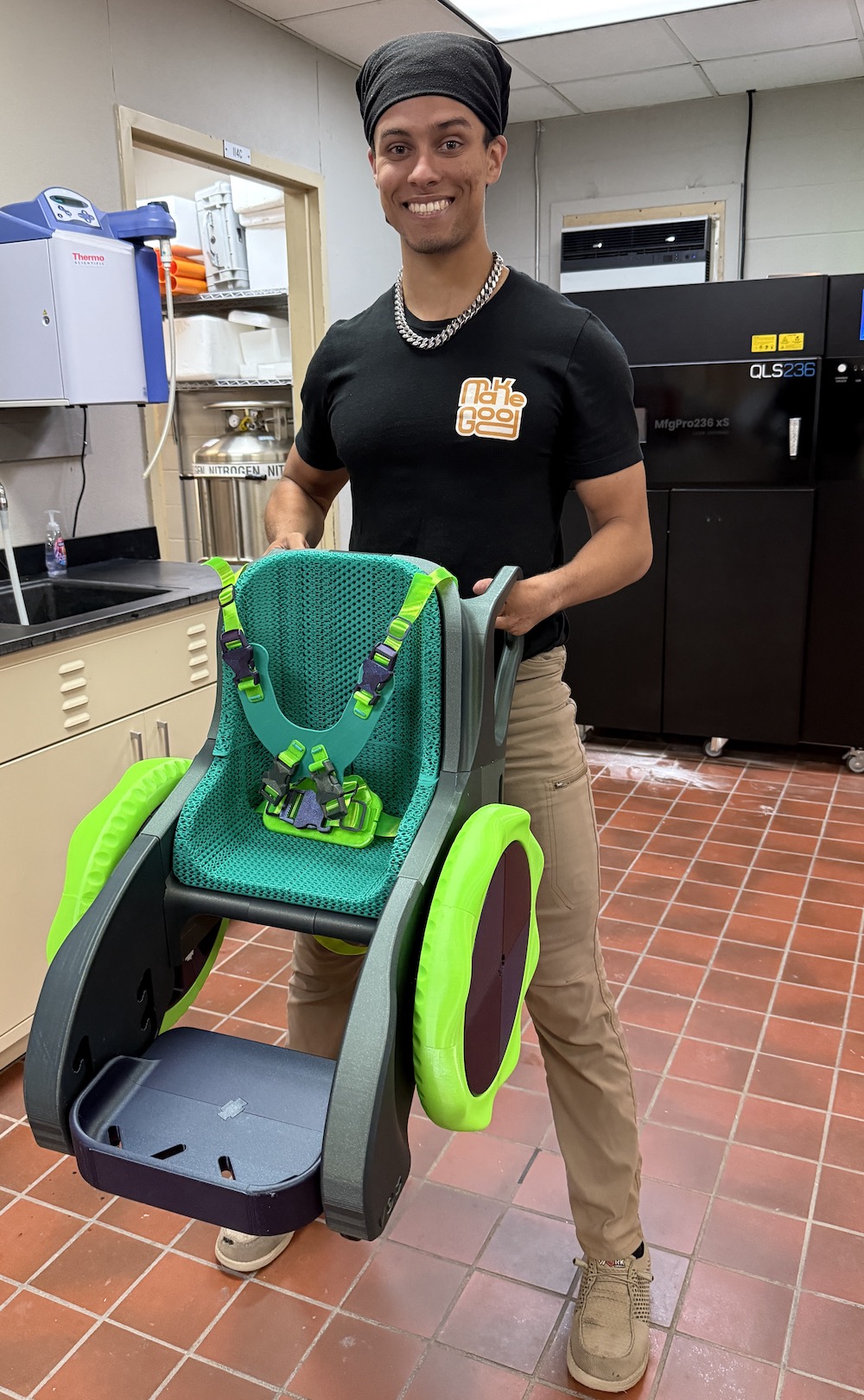
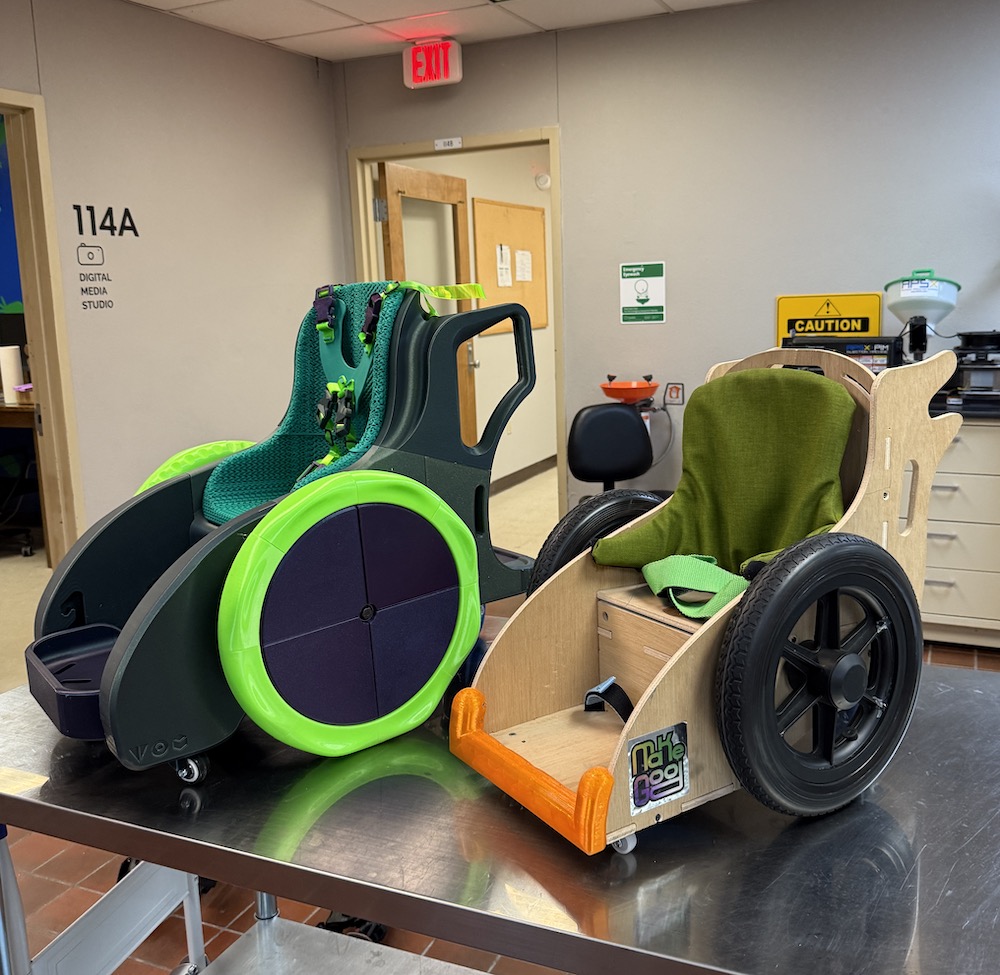
Perhaps MakeGood’s most exciting product is the 3D toddler mobility trainer. Because many toddlers crawl, agencies can downplay the need for mobility devices, despite the importance of movement on brain development and independence. Parents can now print their own while waiting for agencies to provide medical grade devices. The MakeGood device, including wheels, straps and soft cushion can be printed in preferred colors.
Once printed, the pieces snap together. Should a piece break or become overused, parents can reprint individual parts. Noam Platt, the director of MakeGood and a certified healthcare architect, assures durability. “If parents use suggested products, kids will likely outgrow the device before they need to replace anything,” says Platt.
Consumers should note: Because parents use a prototype design to print their own device (as opposed to buying a product) liability falls on parents based on user choice of printer and printing materials.
Parents often become innovators as well. Faced with the sudden loss of her husband (and his many skill sets), Mary Akers had two choices: give up or learn to use his power tools. Nothing seemed to fit her daughter Amelie correctly; and the continual disagreement between school, insurance and state funding sources was wearing the family down.
“It got to the point where I was spending more time and effort staying on top of insurance claims…than acquiring supports or solving problems,” says Akers. “At some point, you have to dig deep and start doing things for yourself.”
To support Amelie, Akers found a cadre of parents online who build or adapt equipment, trade ideas and post successes. “There are hundreds of Pinterest boards devoted entirely to adaptive solutions and some of them have great downloadable plans,” says Akers. “I just dusted off the workspace and started creating.”
Amelie (age 12) has cerebral palsy and is unable to move the lower half of her body on her own. She uses a power chair, an upright stander and a push chair, depending on the need. Amelie is fully capable of dressing the top half of her body, but requires tools to get her clothes off the rack and over her head.
Using a circular table saw, Akers cut a series of dowels to different sizes and screwed plastic covered cup hooks into one end of each. Amelie uses these to hook clothes on hangers from her closet and choose outfits without help. Akers also cut a series of irrigation pipes to slip under the legs of Amelie’s desk so that her power chair fits easily under it. There are folding table risers available online (www.liftyourtable.com is a great source), but sometimes it is hard to find the right height and circumference needed. Akers also replaced the closures on Amelie’s jewelry with magnets that allow for quick changes using a needle-nosed plier designed for the task.
To increase independence with standing, Akers modified a shovel so that Amelie can slip the handle over her foot to lift and place her foot on the floor. Then they use a DIY plywood tool (that has hand holes on each side) to use their combined strength and lift her up.
Being upright is important for Amelie as it stretches out her chest, improving circulation, respiration, digestion and bone density. “Plus, when she stands, she looks her peers in the eye,” says Ackers. “It helps build friendships and stops people from seeing her as helpless. Using these devices also makes it easier for me to support her without hurting myself.”
Christie Manzano’s son Ezekiel has Cornelia de Lange Syndrome (CdLS) and autism. CdLS can result in significant GERD and excessive drooling. Ezekial is a sensory seeker and loves weighted products, but his drooling destroyed many. Manzano used a pattern (www.seekatesew.com/how-to-make-a-weighted-blanket) to create a duvet-type cover.
“The original was soft fleece on one side and a dollar store plastic tablecloth on the other, so I could wipe off the drool,” says Manzano. “Then, I found pliable vinyl that increased the number of times it could be washed before replacing.” Kate Blocher of See Kate Sew recommends using poly pellets; some parents use pony beads for washability. Ezekial prefers the feel and weight of dry beans.
Manzano also added weight to his favorite plush Pokémon by replacing some of the stuffing with small, round stones. Be sure not to exceed 5–10 percent of a child’s body weight with any weighted product; and never give weighted products to infants or unattended children who cannot get out from under them.
Creative parents often find solutions to their child’s specific needs, but there is no shame in purchasing products if you don’t have the tools or time. For a full list of companies that offer adaptive tools and equipment, see the resources under Adaptive Equipment.
Emily Dolton is an artist, maker and mom of two, one with 22q 11.2 DS.
Photos courtesy of MakeGood
Leave a Reply